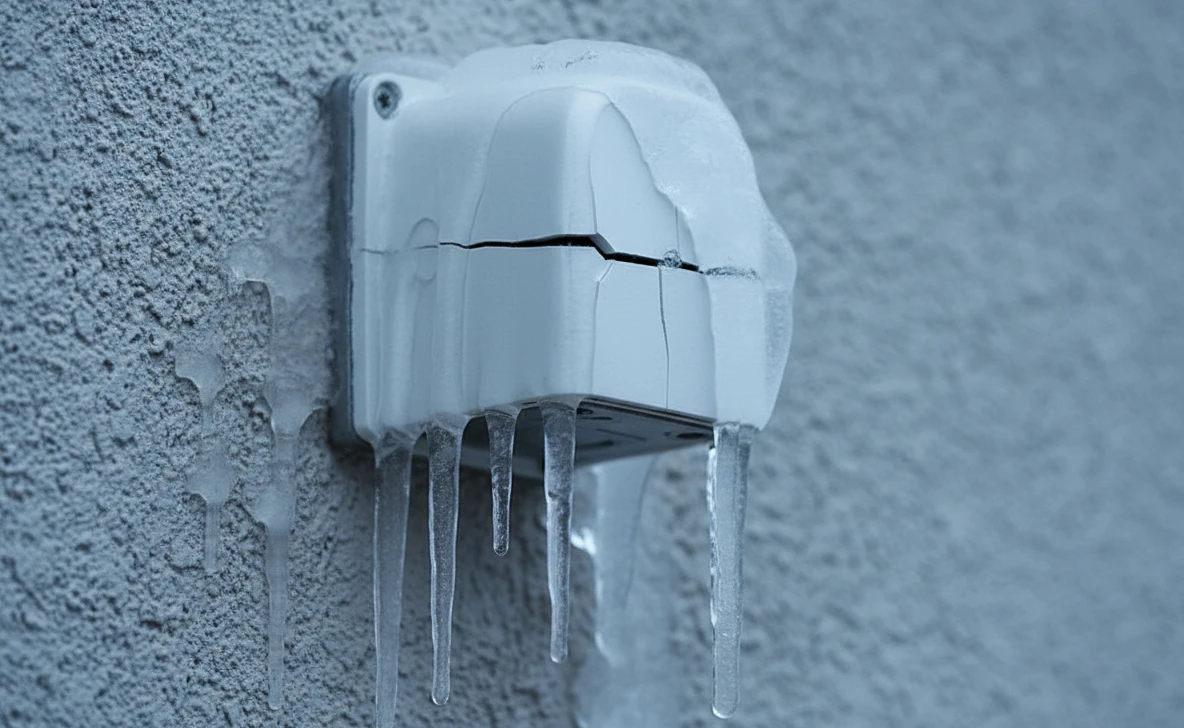
What causes low-temperature cracking in injection-molded outdoor surveillance housings?
There are mainly 3 common causes:
- Material issues: ABS itself has insufficient low-temperature resistance and becomes brittle at low temperatures; if the material has a relatively high glass transition temperature or insufficient toughness, it is also prone to cracking. Common suggestions in discussions are to switch to PC/ABS or apply toughening or elastomer modification. However, the key is to complete sufficient verification in advance, such as testing -20°C cold resistance according to international standards and requiring the supplier to provide a third-party certification report. Otherwise, no matter how good the selected material is, it will be useless.
- Process issues: Improper control of injection molding temperature, pressure, holding pressure, and cooling can cause excessive internal residual stress in the housing; unreasonable mold cooling channel design can also cause uneven shrinkage. It is also necessary to closely monitor the supplier’s data transparency and regularly calibrate equipment parameters; otherwise, cracking is especially likely during low-temperature testing.
- Design issues: Unsmooth wall-thickness transitions and sharp or acute corners easily create stress concentration; some cases also mention that failure to perform proper annealing after injection molding can further increase the risk of low-temperature cracking.
How to confirm the material’s low-temperature resistance before injection molding?
| Pre-injection confirmation point | Method |
|---|---|
| Check documentation first | Ask the material supplier to provide the TDS and third-party low-temperature report, and clearly specify the brand and grade |
| Small samples before mold opening | Conduct small-sample testing first to verify whether the physical properties are consistent with the TDS |
| Critical low-temperature resistance | Conduct DSC testing for Tg according to the reference standard, and then carry out low-temperature impact / brittleness temperature testing according to the standard |
| Reference standards | ASTM D746, GB/T 5470, ISO 179-1, ASTM D256, IEC 60068-2-1 |
| Prevent disputes | Retain sealed samples, trial-mold verification, and small-batch validation, and write the indicators and standards into the agreement |
How to test the low-temperature resistance of injection-molded outdoor surveillance housings?
The focus of finished-product testing is whether the part will become brittle, crack, or remain dimensionally stable after cooling. Common methods are as follows:
- Low-temperature impact test: Refer to ASTM D256 for Izod impact testing to evaluate the risk of low-temperature brittle cracking in security housings (the original standard mainly measures impact strength, and low-temperature testing requires an additional cooling chamber).
- Low-temperature chamber / thermal shock test: Refer to GB/T 2423.1, place the security housing into a low-temperature chamber or thermal shock test chamber, and observe cracking, deformation, and dimensional stability.
- Low-temperature tensile / flexural test: Refer to ISO 527-2, ASTM D638, and ISO 178 to check changes in tensile strength, elongation at break, and flexural strength.
- Simple in-house screening: At -30°C, dry ice + alcohol can be used for simulation, followed by manual bending or impact to determine whether brittle cracking occurs (for preliminary screening only, not a substitute for standard testing). Pay attention to safety.
What clauses must be clearly defined in a contract for custom injection-molded low-temperature-resistant outdoor surveillance housings?
| Clause | Content that must be clearly written in the contract |
|---|---|
| Low-temperature performance | The lower temperature limit must be explicitly written as -30°C or -40°C, and the test items, test conditions, and acceptance criteria must be agreed upon. It is not enough to simply state “low-temperature resistant.” |
| Sealed sample acceptance | The first article shall be confirmed and signed off by both parties and sealed as a sample, which will serve as the reference basis for subsequent mass production, delivery, and dispute resolution. |
| Material specification | The material grade, certification number, and whether substitute materials are allowed must all be clearly listed. Any change requires written confirmation. |
| Trial molding and maintenance | The number of trial runs, the materials used for trial molding, mold maintenance responsibilities, and the trigger conditions for free mold repair during the warranty period must be agreed upon in advance. |
| Compensation liability | If cracking, scraping, or trial-molding loss is caused by mold design or processing issues, the supplier shall bear responsibility; the compensation process, proportion, and upper limit must be written in advance. |
How should responsibility be determined in quality disputes over low-temperature-resistant housing mold opening and injection molding?
If a problem occurs, do not rush and do not argue first. Determine responsibility first and review the evidence chain first:
- First check the contract / technical agreement: whether the minimum service temperature, test standards, and acceptance method are clearly specified.
- Then check the material: whether the grade was agreed upon and whether a low-temperature verification report for the material (such as third-party certification) was required. If the supplier changed the material without authorization, added regrind, or falsified verification, the main responsibility lies with the supplier.
- Then inspect the mold and process: Follow the sequence of “mold first, then process”; mold defects are mold responsibility, while improper parameter settings are injection molding responsibility.
- Finally, submit to a third-party test: Use the report as the basis for negotiating compensation, rework, or remanufacture.
If you are evaluating an Injection Molding Manufacturer or Injection Molding Supplier for this type of housing, the core issue is still whether low-temperature material verification, mold design, and process control can be clearly defined in advance.