
1. Structural Design: Durability and Detail Optimization
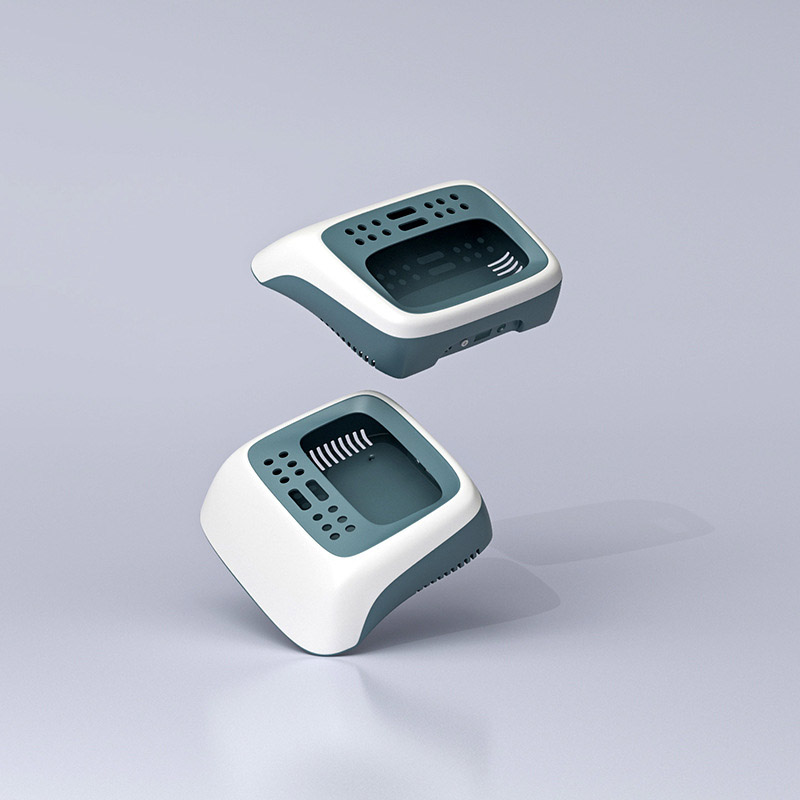
- Folding mechanism: Uses PA66 + 30% glass fiber (tensile strength approx. 85 MPa). Snap-fit corners use fillets with R = 2.5 mm and an additional 0.8 mm reinforcing rib. When combined with a 0.3 mm preloaded silicone washer, the assembly can withstand 2,000 folding cycles (about 1 year of use).
- Battery compartment cover: Four symmetrically arranged snap-fits (height 2.8 mm), with a 0.6 mm silicone pad (Shore A 50) on the inner side and 0.5 mm reserved space for battery expansion. This design effectively eliminates looseness and rattling noise.
- Anti-pinch safety design: Outlet grille spacing ≤ 3.5 mm, with the edge overmolded by a 0.3 mm TPE soft layer (Shore A 40). The clearance between the fan blades and the grille is ≥ 12 mm, meeting the anti-finger entrapment requirements of GB 12350-2020, “Safety requirements for small power motors”.
2. Materials and Wall Thickness: Balancing Strength and Weight
- Mainstream materials: ABS with wall thickness 1.5–2.5 mm, PP with wall thickness 1.5–2.0 mm. Avoid using standard PS (high brittleness; requires a wall thickness≥ 1.8 mm).
- Zoned optimization: Grip area (handle) 2.0–2.5 mm for anti-deformation performance; non-grip area (outlet shroud) 1.5–1.8 mm for weight reduction. Wall thickness variation should be ≤ 0.5 mm to prevent sink marks.
- Key targets: ABS outer housing weight controlled at 105–165 g (excluding internal structural parts); total fan weight ≤ 180 g, which aligns with user-perceived “lightweight” threshold. Fan must pass 1 m drop tests without cracks when combined with 0.8 mm reinforcing ribs.
3. Inlet and Outlet Airflow: Efficiency and Noise Control
- Area ratio: Inlet area = outlet area × 1.3 (± 0.1). For example, with a 10 cm² outlet, the inlet should be designed at 13 cm² to balance airflow efficiency and noise optimally.
- Structural optimization: The inlet adopts a honeycomb / multi-hole pattern (porosity 60–70%) with a 15° inward chamfer at the edges. The outlet uses a “sparser center, denser edge” grille layout (center spacing: 12 mm; edge spacing: 8 mm), with grille bars tilted 15° to guide airflow. This improves the uniformity of air velocity across the outlet to within ±0.8 m/s.
4. Low-Noise Motor: Core Performance Selection
- Brushless DC motors (BLDC) as first choice: Compared with brushed motors, BLDC designs typically reduce noise by 10–15 dB. Representative models include:
- Domestic: JD-365 (Φ28 × 15 mm, 32 dB @ 2,000 RPM), Welling WL-2805 (supports adaptive PWM speed control);
- Imported: Nidec U70 (Φ20 × 12 mm, 28 dB @ 1,800 RPM, low-noise bearing design).
- Noise reduction details: PWM frequency > 25 kHz to avoid audible whine. A 2 mm butyl rubber damping pad is placed between the motor and housing. Fan blades adopt a biomimetic curved profile in PC/ABS to further reduce aerodynamic noise.
5. Ergonomics and Portability
- Grip design: Handle diameter 42–45 mm with a surface wave texture 0.8 mm in depth and 3 mm in pitch. A 15° concave curvature at the web of the thumb reduces hand fatigue, lowering the user fatigue feedback rate from 62% to 18%.
- Foldable portability: Three-section folding architecture (7 cm handle section + 5 cm motor section + 6 cm outlet section). Folded length ≤ 11 cm, making it suitable for small ladies’ handbags (approx. 18 cm × 12 cm).
Conclusion: Developing a handheld fan requires balancing structural strength, low-noise performance, lightweight design, and user experience. Focusing on core parameters — “brushless motor, 1.3× inlet-to-outlet area ratio, and 2.0 mm zoned wall thickness” — and combining them with detailed optimizations (snap-fits, anti-pinch design, grip texture) can significantly enhance overall product competitiveness.