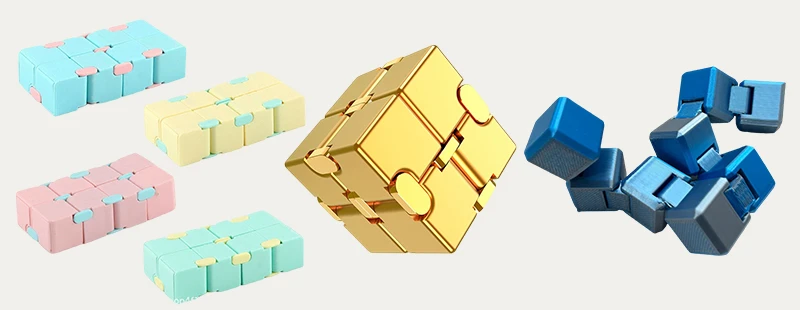
What is an Infinity Cube?
It is a lightweight hand stress relief toy composed of modular units with folding and rotating shafts, enabling infinite cyclic shape transformation. It features portability and quiet operation, helping users relieve stress and kill fragmented time. It is also often classified as a subcategory of EDC (everyday carry) toys.
What are the functions of an Infinity Cube?
- Workplace Stress Relief: Quiet design alleviates anxiety during meetings and remote work.
- Learning Concentration: Improves focus during exams and self-study, reducing irritability.
- ADHD Assistance: Tactile stimulation manages energy and enhances concentration.
- Hand Training: Helps middle-aged and elderly people or computer users relax their hands.
- Emotional Counseling: Relieves postpartum anxiety and obsessive-compulsive disorder, bringing a sense of control.
- Social Icebreaker: Serves as an interactive prop to reduce social pressure.
- Portable Stress Relief: Small size and quiet operation, suitable for commuting and waiting in line.
How Many Structural Designs Are Available for Infinity Cubes?
| Structure Type | Structural Features | Advantages | Disadvantages | Applicable Scenarios |
|---|---|---|---|---|
| Snap-on Type | Assembled with plastic snaps | Low cost, simple structure, and easy production | Easy to wear, poor durability | Mass production of affordable toys, daily use by students |
| Magnetic Type | Adsorbed by NdFeB magnets | Smooth hand feel, quiet switching | Fear of falling, magnets easy to shift or demagnetize | Office stress relief: quiet environments such as libraries |
| Hinged Type | Connected with metal hinges | High durability, stable structure | Heavy weight, relatively loud noise | Hardcore hobbyists, high-frequency use scenarios |
| Slider Type | Rail sliding | Low noise, high precision | High-precision requirements, relatively high cost | Scenarios with strict noise requirements, such as libraries and classrooms |
What Materials Can Be Used to Make Infinity Cubes?
| Material | Durability | Hand Feel |
|---|---|---|
| ABS Plastic | Average (snaps easy to loosen) | Light and thin |
| PC Plastic | Good (high toughness, difficult to break) | Firm and textured |
| Aluminum Alloy | Excellent (no looseness, fall-resistant) | Heavy and substantial |
| Stainless Steel | Extremely excellent (no wear) | Heavy and hardcore |
| Wood (Beech) | Poor (fear of water and falling, easy to crack) | Warm and natural |
How to Make Rapid Prototypes for Infinity Cubes
The following are the prototyping methods for infinity cubes, which can be determined according to your needs.
| Material | Process | Applicable Scenarios |
|---|---|---|
| Acrylic | Laser Cutting | Low-cost rapid prototyping, suitable for individual developers and student concept verification |
| Wood Board | Laser Cutting | Handmade DIY prototyping, low-cost sample production |
| Plastic (ABS/PC) | 3D Printing (FDM/SLA), CNC Machining | FDM for rapid low-cost structural verification; SLA/CNC for high-precision and pre-mass production testing |
| Resin | Silicone Mold Duplication and Casting | Small-batch sample replication, cost reduction, suitable for market testing |
| PU | Silicone Mold Duplication and Casting | Small-batch durable samples, optimized hand feel for display or testing |
| Metal | CNC Machining or Standard Parts Installation | Key components such as rotating shafts, improved durability and hand feel, and suitability for high-demand designs |
| Silicone | Molding or Casting | Flexible parts or mold making, suitable for special needs or soft samples |
| Cardboard | Hand Cutting and Assembly | Ultra-low-cost display, only for photography or very preliminary concept verification |
Injection Molding Production Process of Infinity Cubes
| Module | Core Content |
|---|---|
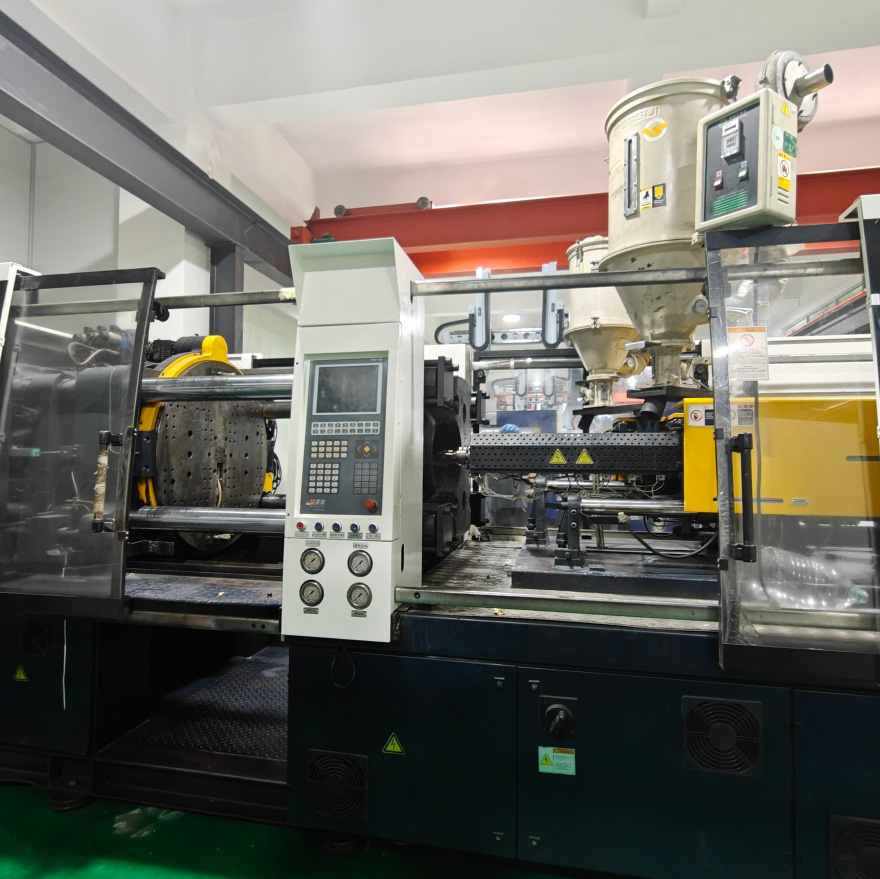
| Mold Cavity Selection Method | 1. Cost Priority: 2 cavities for small batches 2. Capacity Priority: 8 cavities for large batches 3. The specific number of mold cavities shall be determined according to product size. |
| Material Selection Logic | 1. Ordinary ABS/PP can be mixed with an appropriate amount of recycled materials (such as sprue materials) 2. High-grade, food-grade ABS/PP, no recycled materials, in compliance with target market certification requirements (such as CE, RoHS) |
| Post-processing Methods | Ordinary models: Ultrasonic cleaning to remove sprues, grinding/ultrasonic cleaning/local polishing/thermal aging treatment |
| Surface Treatment Solutions | Electroplating, spray painting, oil spraying, and pattern printing. |
| Key Points of Quality Inspection | Check snap tension, warpage rate, and defect rate; provide material/environmental certification |
CNC Metal Machining Production Process of Infinity Cubes
| Step | Name | Description |
|---|---|---|
| 1 | Raw Material Preparation and Cutting | Select materials and cut into blanks |
| 2 | CNC Rough Machining | Clamp and rough mill to remove most excess materials and leave machining allowance |
| 3 | CNC Finish Machining | Use finish machining tools for milling to ensure key dimensions and geometric accuracy |
| 4 | Deburring Treatment | Remove burrs generated by machining to make edges smooth |
| 5 | Surface Treatment | Typical processes (for aluminum alloy) may include sandblasting, wire drawing, and anodizing |
| 6 | Assembly and Debugging | Splice all components and debug to ensure flexible rotation |
| 7 | Final Quality Inspection | Check rotation smoothness, part clearance, surface appearance, etc. |
Summary
The Infinity Cube is a lightweight and quiet hand stress relief toy that realizes infinite shape transformation through modular design, suitable for various scenarios such as workplace and study, helping to relieve stress and improve concentration. Its structures include snap-on, magnetic, hinged, slider, and other types, and materials can be plastic, metal, or wood to meet different hand feel and durability requirements. Prototyping can be quickly verified by laser cutting, 3D printing, CNC, mold duplication, and other methods, while mass production involves injection molding or metal processing technology. Dongguan Shibang Plastic Products Co., Ltd. provides a one-stop solution from design mold manufacturing to injection molding assembly, ensuring the quality and efficiency of products from prototyping to mass production.