Fortune Business Insights puts the 2025 global stress relief toy market at US$9.01 billion, while Mordor Intelligence estimates it at US$9.07 billion. The two figures are almost identical. The market is already sizable, but the number that matters more for brand owners is the structure behind it: a compound annual growth rate of 6% to 8%. That points to steady expansion, not a one-off boom.
Steady growth means that even after stripping out the products that go viral overnight and disappear just as fast, the category as a whole is still expanding. For brand owners, that comes down to two points. First, demand tied to emotional wellness and attention management is long-term, not a short-lived trend. Second, revenue is increasingly concentrating in the hands of companies that consistently get compliance, materials, and functionality right. Businesses that simply chase hype are less likely to benefit.
US$9 Billion Market, Driven by Steady Growth Rather Than a One-Time Craze
Research firms point to similar growth drivers: rising awareness of mental health, sensory needs among people with ADHD and autism, stronger focus on attention management in schools and workplaces, and viral exposure on social media platforms such as TikTok. Both firms list these as the main forces behind market growth.
By region, North America is the largest consumer market, accounting for about 41% of global demand. Asia-Pacific, however, is the fastest-growing region, with a CAGR of about 8.85%. For supply chains with capacity in China and Southeast Asia, that alignment is favorable—the fastest-growing market is also the closest.
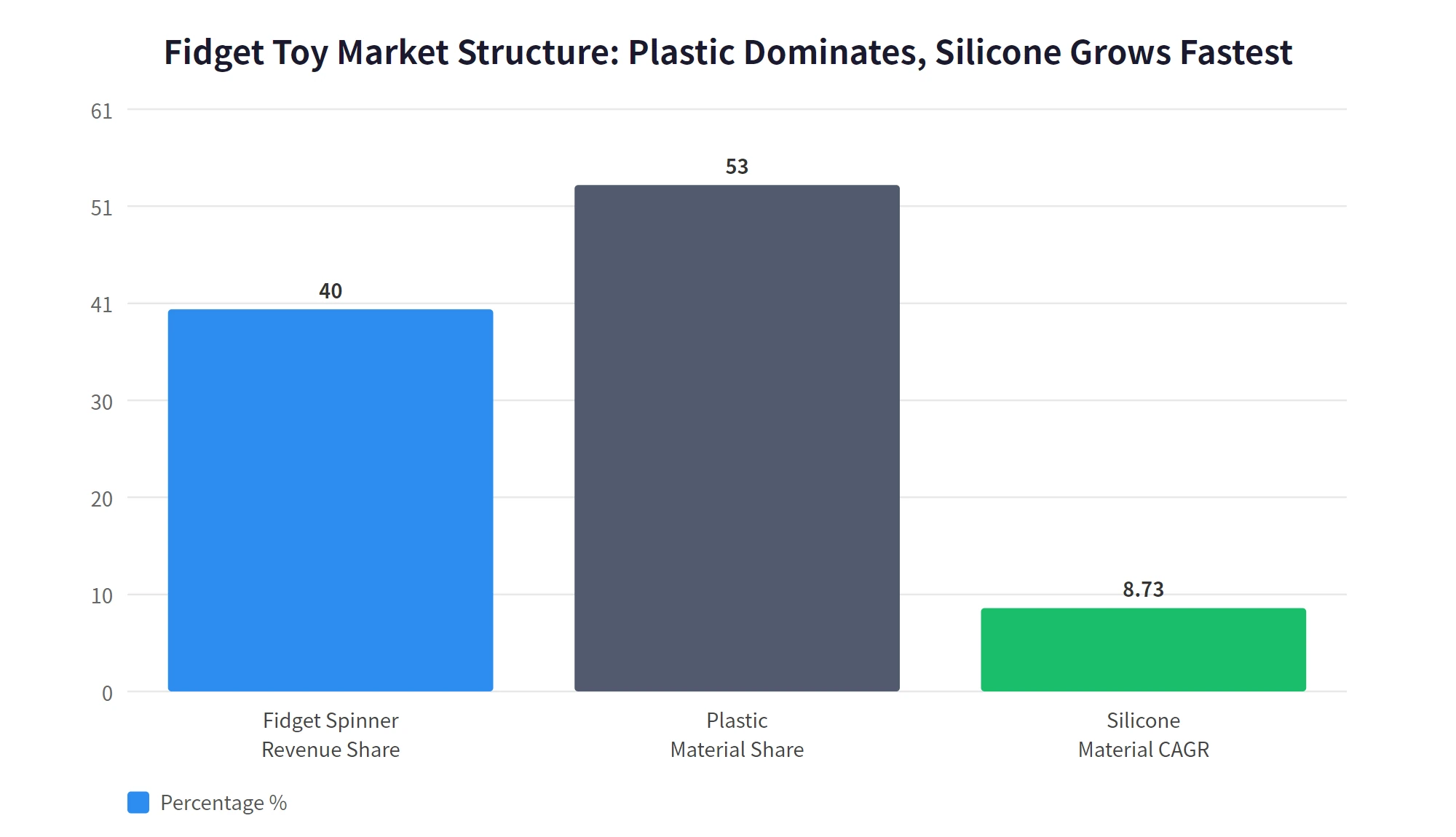
The internal product mix is even more revealing. According to Mordor Intelligence, fidget spinners will still account for about 40% of stress relief toy revenue in 2025. Plastic remains the dominant material at about 53%. Silicone, however, is the fastest-growing material segment, with a CAGR of about 8.73%.
Taken together, these figures show several things. Novelty-driven products still carry significant revenue momentum. Plastic remains the mainstream shell material. At the same time, materials are shifting toward safer, more premium silicone. That shift reflects stronger parental focus on non-toxic materials, along with tighter toy safety regulations in the EU and China.
This article focuses only on injection-molded and compression-molded stress relief devices, including squishies, Pop It toys, fidget spinners, fidget cubes, infinity cubes, and magnetic cubes. Non-injection categories such as slime, kinetic sand, and fluid-based products are outside the scope of this discussion.
Stress Relief Toys Fall Into Three Categories: Soft Plastic, Rigid Plastic, and Silicone
Breaking the category down by material is more useful for product decisions than grouping by play pattern. Injection-molded stress relief toys generally fall into three lines.
| Type | Representative Products | Mainstream Materials | Process Features |
|---|---|---|---|
| Soft plastic | Squishies, stress balls | TPE/TPR soft compounds (SEBS-based) | Slow-rising feel, Shore A 10–40 |
| Rigid plastic | Fidget spinners, fidget cubes, infinity cubes, magnetic cubes | ABS/PP housings + metal inserts | Insert molding, wall thickness, and tolerance control |
| Silicone | Pop It toys, silicone squishies | Food-grade platinum-cured silicone | LSR injection molding or solid silicone compression molding |
The core of soft plastic products is tactile feel. The slow-rising response of squishies comes from SEBS-based formulations, with typical hardness in the Shore A 10–40 range. The softer the part, the higher the oil loading. That also makes mold sticking and oil bleed more likely—one of the hardest process issues in volume production.
Rigid plastic products follow a different logic. Fidget spinners use ABS or PP housings with steel bearing inserts. Fidget cubes use ABS multi-face button structures. Infinity cubes rely on linked hinges. Magnetic cubes use ABS housings with neodymium magnet inserts. What they have in common is a rigid plastic shell plus metal inserts, which places clear demands on insert molding and wall-thickness tolerance control. Two-shot or overmolding processes can add a soft-touch layer to fidget cubes or combine soft and rigid zones in squishy products. The challenge is whether the two materials bond securely.
Silicone products are represented by Pop It toys. The mainstream material is food-grade platinum-cured silicone. It is BPA-free and washable. There are two main molding routes. LSR injection molding cures quickly, offers better odor performance, and suits high-volume production. Solid silicone compression molding suits lower-volume, thick-wall parts. In one export silicone wheel alarm clock project, Worldboundgroup adjusted silicone hardness from Shore 45A to 65A. A 20-point shift is not a minor tweak. It requires formulation changes, including the silica filler ratio and curing system. The project was brought into stable production with a consistent feel, showing that Worldboundgroup can handle cross-range hardness adjustment at both formulation and mass-production levels.
The IP Lesson of the Fidget Spinner Is What Brand Owners Should Study Most Closely
No discussion of stress relief toys can avoid the fidget spinner. It was not just a hit product. It was also a textbook IP case.
Inventor Catherine Hettinger obtained a patent in 1997, gave it up in 2005 because she could not afford the US$400 renewal fee, and the patent expired naturally in 2014. According to an analysis published in the Fordham Intellectual Property, Media & Entertainment Law Journal, the design of the modern fidget spinner does not fall within the claims of her original patent. That means manufacturers producing today’s fidget spinners are not, from a technical standpoint, infringing that patent.
This distinction matters. The issue was not widespread infringement by the whole industry. It was the combination of patent expiry and non-infringing product design. Once that happened, the category was flooded with entrants and quickly became homogeneous. For brand owners, the takeaway is straightforward: if the only competitive angle is a hit product shape with no barrier to entry, the likely outcome is a price war.
The product lifecycle is even more instructive. The fidget spinner was named Product of the Year by the promotional products industry in 2017, then search volume bottomed out by 2020. Pop It products saw promotional-industry search volume surge by about 30,000% in 2021, then decline over the next two years. Respondents interviewed by ASI Central put it plainly: no one buys a press-and-pop stress toy on its own unless it has been turned into something functional.
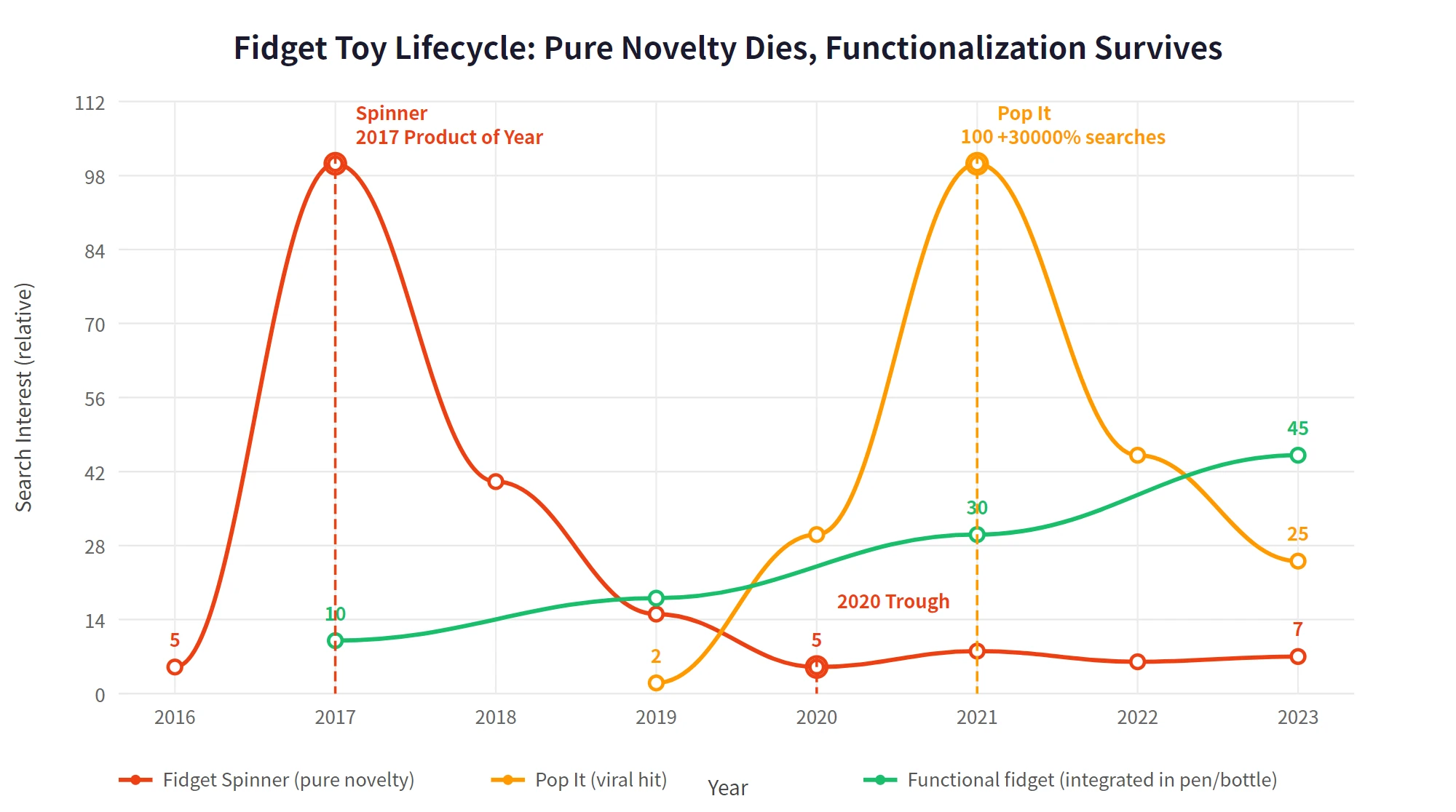
Pure fad products and functional products follow two different paths. Pure novelty fades. Products integrated into pens, water bottles, balls, and other everyday items have a better chance of extending their lifecycle. The market’s overall 6% to 8% steady growth is not being driven by repeated replay of one viral hit. It is being supported by functional products that can sustain repeat purchases and steadily take share.
Do Soft Plastic Squishies Need 8P Phthalate Testing?
Yes. This is one of the most common compliance traps for brand owners.
Under the U.S. CPSIA, each of eight phthalates in any plasticized component of a children’s toy intended for children under age 14 must not exceed 0.1% (1,000 ppm). These eight substances are what the industry refers to as 8P phthalates: DEHP, DBP, and BBP are permanently banned, while DINP, DIBP, DPENP, DHEXP, and DCHP were added under 16 CFR 1307.
The detail most often missed is the phrase “plasticized component.” Many people assume phthalate restrictions apply only to PVC. They do not. Any soft, plasticized component is covered. That includes touchable soft parts in TPE or TPR squishies, and even touchable soft components in silicone squishy products. If a stress relief toy is positioned for ages 3 and up and includes accessible soft components, this requirement is usually unavoidable.
EU requirements are no less strict. Under EN 71 and REACH, DEHP, DBP, BBP, and DIBP must each remain below 0.1%. For toys that can be placed in the mouth, DINP, DIDP, and DNOP are also limited to 0.1%. China applies GB 6675, and Japan uses the ST standard. Brand owners must meet the rule set of the target market. Exports to the U.S. require a CPC certificate, while exports to the EU require CE marking.
Compliance is not an area to cut costs. The cost of a recall triggered by excessive phthalates is far higher than the cost of testing up front.
Small Parts and Magnet Ingestion: Hard Thresholds Under ASTM F963
Beyond phthalates, physical safety is the next gate. ASTM F963 is the main toy safety standard in the United States.
The core requirements are straightforward. Toys for children under 3 must not contain small parts to prevent choking. Children under 3 have an airway diameter of only about 4 mm. Toys must not have sharp edges or points. They must pass use-and-abuse testing that simulates pulling, biting, and dropping. Soluble heavy metals must also meet the standard.
For stress relief toys, age grading is where problems most often arise. Magnetic cubes contain neodymium magnets, which create an inherent small-parts risk. The greater hazard is magnet ingestion. The U.S. CPSC has specific warning requirements for magnetic toys because multiple swallowed magnets can attract inside the body and cause severe intestinal injury. Fidget spinners with metal bearings also require separate age-grade assessment.
A product labeled for children under 3 cannot include any small parts. A product labeled for ages 3 and up still needs to be evaluated for whether small parts may detach during abuse testing. Many brand owners get the age grade wrong during product definition, then discover after tooling that the product cannot pass compliance. At that point, the loss is much larger.
For licensed brands, the compliance threshold on the factory side is even higher. Brands such as Disney, Bandai, and NBCUniversal require factories to meet hard qualification standards, including Disney FAMA, IETP, NBCU supplier requirements, and SMETA 4-Pillar audits. Missing even one of these blocks access to branded toy supply chains. This is one of the main reasons many small and midsized factories cannot enter licensed toy programs. Very few factories hold all four at the same time. Worldboundgroup is one of them.
What Keeps the Slow-Rising Feel of TPE Stable
Back to processing. The most demanding part of soft plastic stress relief toys is consistency of tactile feel in mass production.
The slow-rising feel of a squishy is fundamentally a formulation job. SEBS-based TPE typically falls in the Shore A 10–40 range. The softer the material, the higher the oil loading and the greater the risk of mold sticking and oil bleed. That means if melt temperature, mold temperature, and holding pressure are not tightly controlled from batch to batch, the feel will drift. The first lot may feel soft and smooth, while the third becomes firmer or starts to bleed oil.
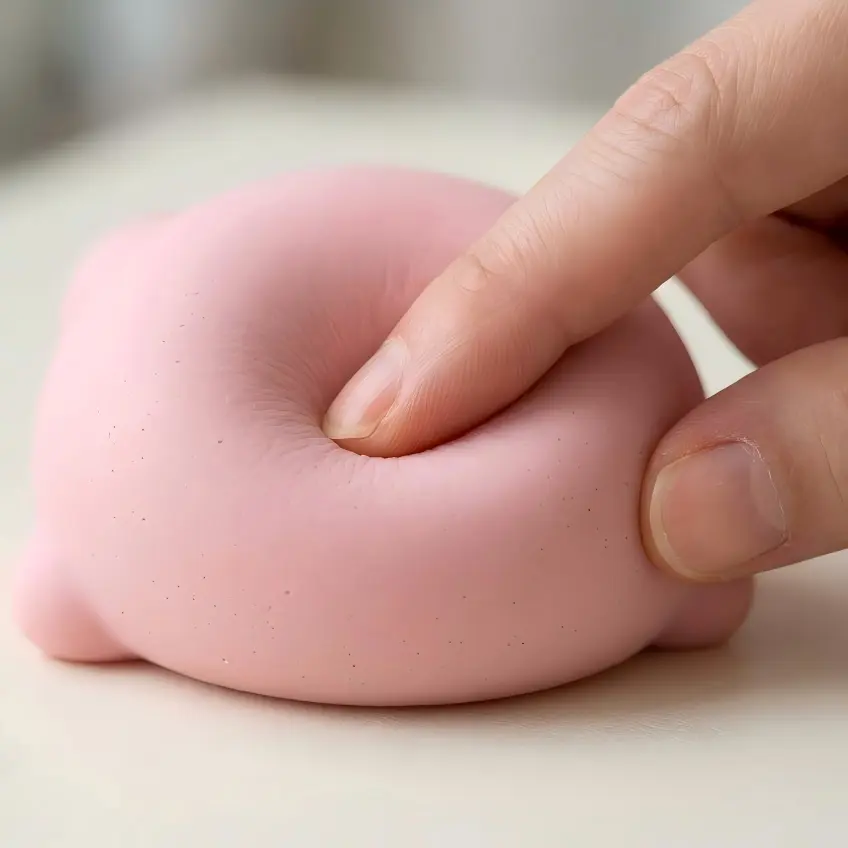
Tactile feel is the first thing consumers judge in a squishy product. It is also the issue most likely to be amplified in e-commerce reviews. When brand owners evaluate an Injection Molding Manufacturer, the question is not just whether it can produce one good sample. The real question is whether it can keep the same feel across 100,000 units in mass production. That requires stable process control plus a profound understanding of SEBS formulations. How soft the product should be, how fast it rebounds, and how much oil it can carry all have to be dialed in through repeated formulation work.
The process barrier for rigid plastic products sits elsewhere. Two-shot or overmolding requires two molds working together. The challenge is the bond strength between the rigid substrate and the soft overmold layer. That depends on material compatibility—whether the melt temperatures and polarity of TPE and ABS or PP can match. Worldboundgroup’s two-shot molding and secondary overmolding capabilities support this type of soft-hard combination in stress relief toys, making the category viable in production.
For silicone products, the choice is between LSR and solid compression molding. LSR suits high-volume, precision, and thin-wall parts, with fast curing and better odor performance. Solid compression molding suits lower-volume, thick-wall parts. The right choice depends on the brand owner’s volume plan and product structure.
Avoid the Red Ocean of Pure Novelty: Three Strategic Landing Points
Looking across the points above, the stress relief toy market is highly fragmented, heavily homogenized, and moving from price competition toward product safety, premium materials, therapeutic credibility, and functionalization—this is also Mordor Intelligence’s view. For factories with compliance and R&D capability, that creates a clear opening to avoid low-price competition and build differentiation.
The first landing point is functionalization. Integrate stress relief features into products with everyday use cases, such as pens, water bottles, keychains, and desktop items. That way, the product is sold not only on novelty but also on daily usefulness. This is the most direct route to extending the lifecycle, and it is where factories with a 50-person engineering team, DFM capability, and functional ODM development can add value. In product development terms, this type of integrated Fun Devices concept is one of the clearest paths for brand owners to differentiate.
The second landing point is material upgrading. Moving away from soft PVC toward food-grade silicone and non-toxic TPE aligns with both parental concern over non-toxic materials and the tightening direction of toy regulations in the EU and China. Silicone’s 8.73% CAGR is not happening accidentally.
The third landing point is compliance credentials. Treat CPSIA 8P, ASTM F963, EN 71, and licensed-brand FAMA qualification as barriers to entry that must be completed early, not patches to apply after problems appear. That approach immediately removes a large share of low-price competitors. For brand owners targeting North America and Europe, compliance is not just a cost. It is a ticket to market entry.
Who Will Capture the Growth
The next stress relief toy that survives is unlikely to be the flashiest one. It is more likely to be the one that is safer, more useful in daily life, and stronger on compliance. The market is still growing at 6% to 8%, but the gains will flow only to the brand owners that get materials, compliance, and functionality right. For brands now evaluating supply chains, sending drawings or a sample list for early review of manufacturability, safety, and compliance is time better spent than comparing unit price alone.