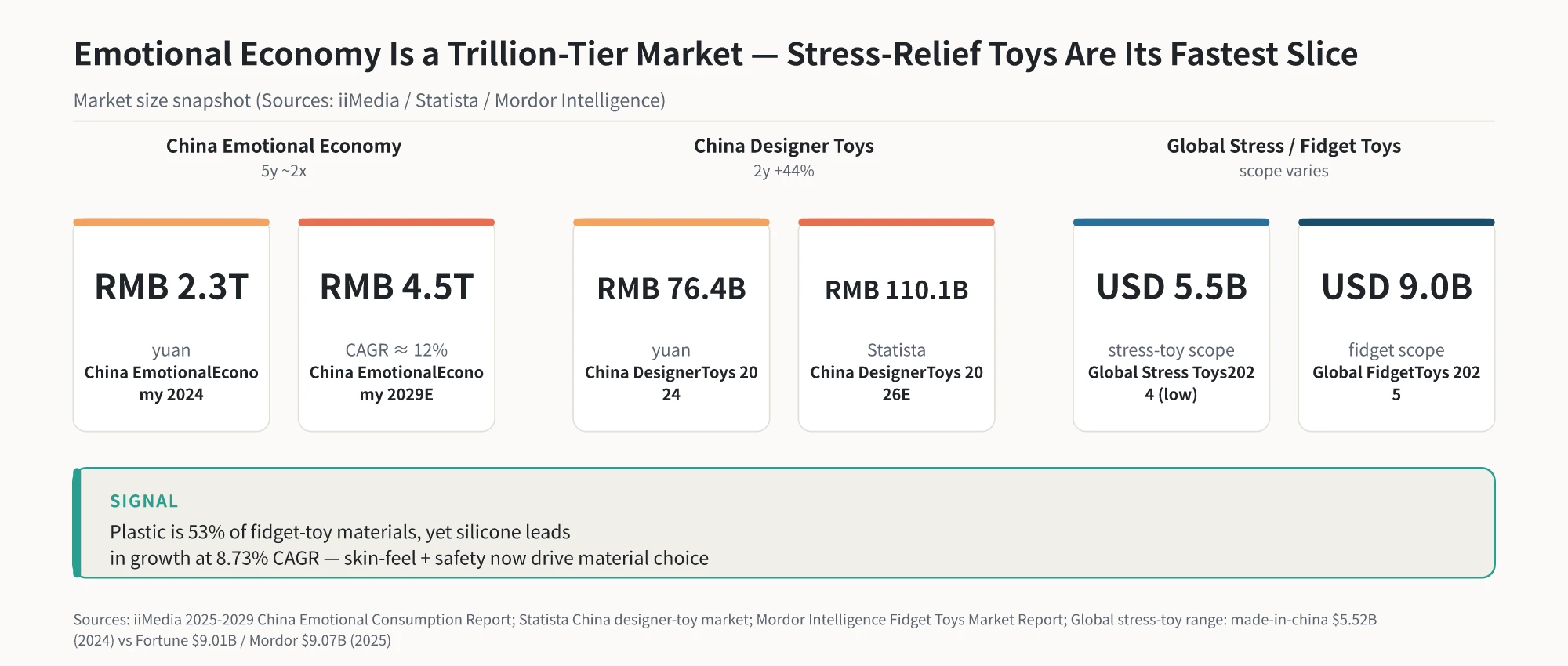
According to data from iiMedia Research, China’s “emotional economy” market is valued at approximately $340 billion in 2024 and is projected to exceed $667 billion by 2029. Citing the same report, the People’s Daily noted that this sector is growing at an average annual rate of about 12%. Zooming out, the global market for stress relief toys in 2024 is estimated to be between $5.5 billion and $9 billion. The wide range is due to different reporting scopes—some agencies only count a subset of pressure toys, while others include the entire fidget toy category. Regardless, the market is substantial.
This means we’re not talking about a niche category waiting for its moment. It’s already a sizable market.
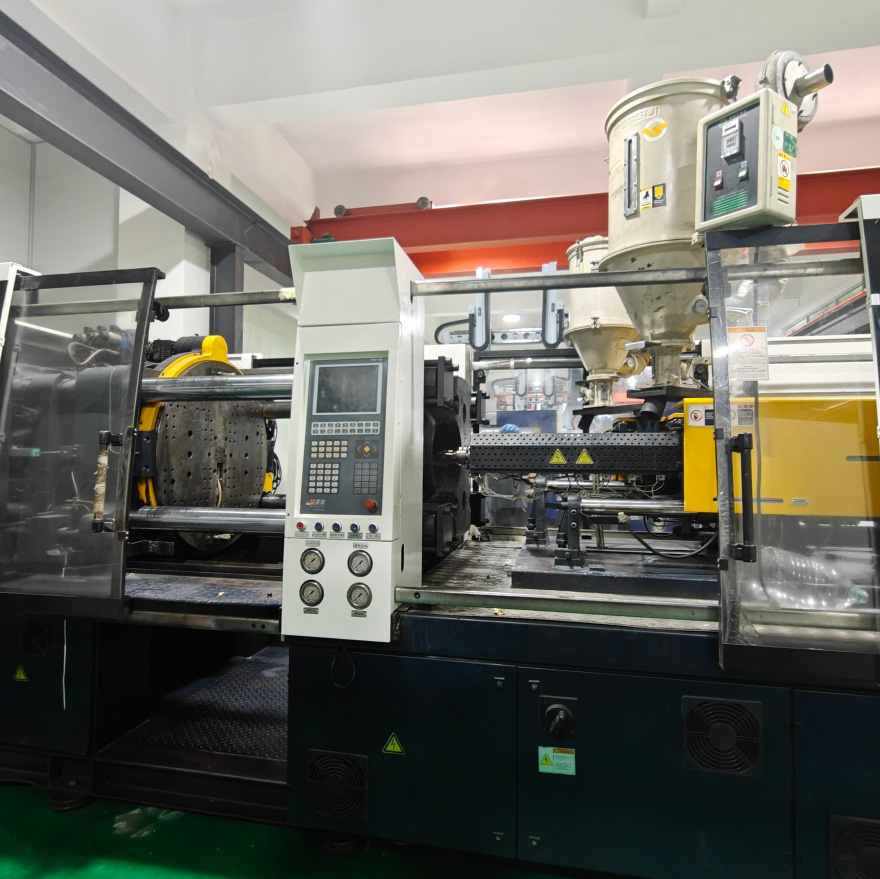
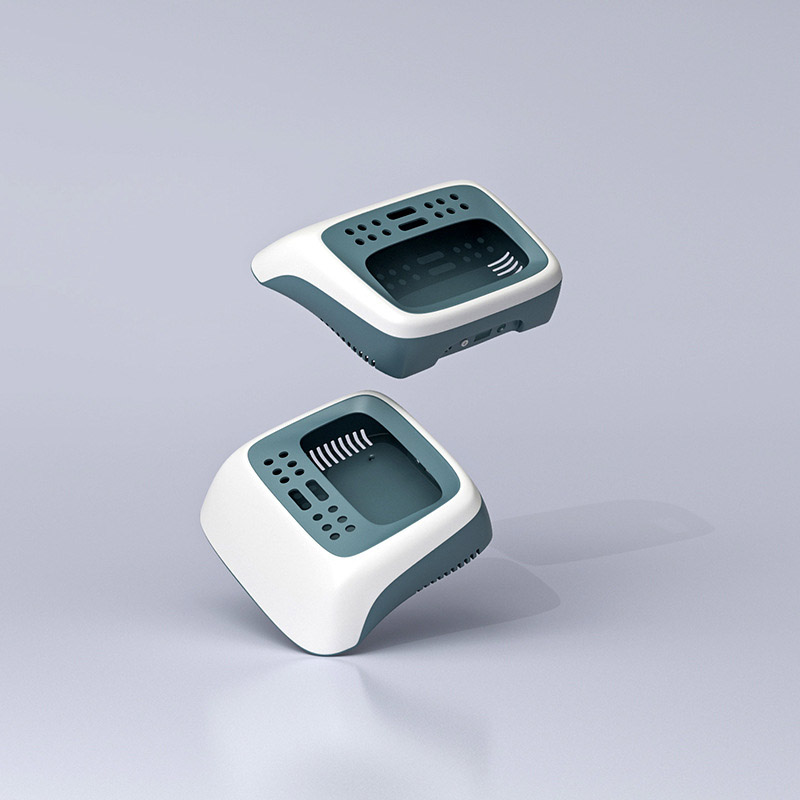
The trend is clear. But the real bottleneck for brands has never been about sales potential. It’s about whether a product can pass certification, be mass-produced consistently, and get accepted into the supply chains of major IP holders. At Worldboundgroup, we’ve been manufacturing Stress Relief Devices for over two decades. We want to walk you through how to turn the consumer trend of “emotional value” into a viable, mass-producible line of injection-molded products.
The Emotional Economy Is a Trillion-Dollar Market, Not a Niche Trend
Let’s start with the numbers. That iiMedia Research report, “Insight into China’s Emotional Economy Consumption Trends 2025-2029,” shows a steep growth curve from $340 billion to $667 billion. Meanwhile, the “2025 Gen Z Emotional Consumption Report” reveals that 56.3% of young people consider “interest and emotional satisfaction” a key driver for their purchases—a figure that’s up more than 16 percentage points from 2024. Nearly 60% of them are willing to pay directly for this emotional value.
Looking at subcategories, China’s designer toy market was worth about $11.32 billion in 2024, and Germany’s Statista projects it will surpass $16.3 billion by 2026. A report from Mordor Intelligence highlights a key point for B2B buyers: while plastic accounts for 53% of the fidget toy market, silicone is the fastest-growing material with a CAGR of about 8.73%. In factory terms, this means skin-friendly feel and safety have overtaken low cost as the primary considerations in material selection.
The Productization Formula Behind Viral Hits: Tactile, Visual, and Social
Many attribute the success of phenomenal products like Pop It and Labubu to “social media magic,” as if it’s all just a matter of luck. But according to The Wall Street Journal, driven by TikTok, North American sales of Pop Its skyrocketed from 700,000 units in 2019 to over 7 million between 2020 and 2021. A single video could increase a product’s sales tenfold. The Labubu wave is even more dramatic. Cailian Press reported that Tmall’s blind box sales grew 207% year-over-year in the first quarter of 2025, with rare “chase” figures reselling for hundreds of times their original price.
But these viral products aren’t random. If you look closely, their success boils down to three repeatable elements:
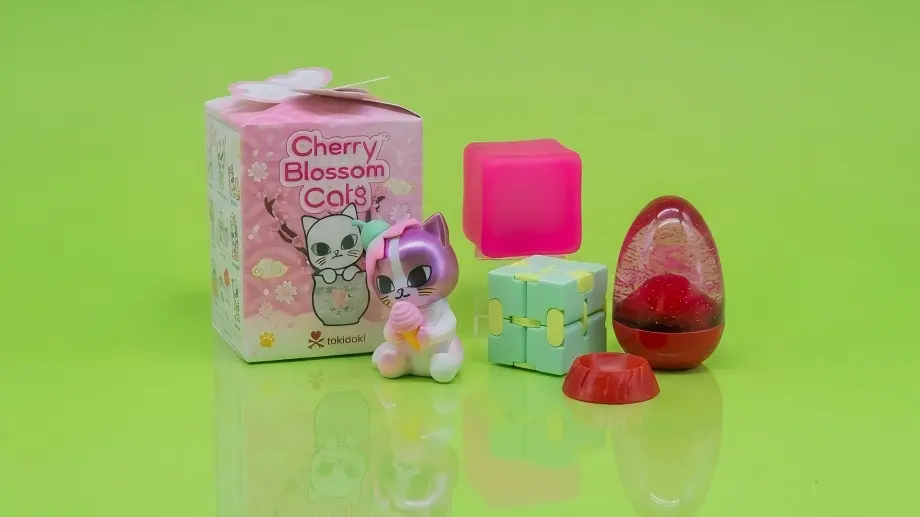
- Tactile Feedback — The spring-back of a squishy, the resistance of a button, or the smooth dampening of a hinge. This is the core of products like slow-rebound toys and infinity cubes, relying on material feel, not complex structures.
- Visual Relaxation — Watching the slow, mesmerizing flow of liquid in a motion timer doesn’t require any user interaction. The visual experience alone is relaxing.
- Social Sharing — Vinyl and plush designer toys, especially those with rare “chase” variants in blind boxes, explode in popularity because they function as social currency. They can be shown off, collected, and discussed.
Combining any two of these is enough to support a product line. For brands, chasing a single viral hit is a gamble. Systematically building a product line based on these three factors is how you turn emotional value into a sustainable business.
Material Selection for Stress Relief Toys: Balancing Feel, Safety, and Cost
Material selection is where things most often go wrong with stress relief toys. The main materials for squishy toys are slow-rebound silicone, TPR (thermoplastic rubber), and food-grade silicone. Low-end TPR and industrial-grade silicone have repeatedly been called out in the media for additive residues.
Based on these cases and data, we can create a decision-making guide that focuses on the application, not just the material itself:
- For tactile-focused squishies — Choose slow-rebound silicone. The feeling of the material slowly returning to its shape is the soul of these products. When a factory talks about “tuning the slow-rebound feel,” they’re adjusting the formulation and curing system, not just a simple hardness parameter. Get the feel right, and the product stands out.
- For safety-first children’s or skin-contact items — Choose food-grade silicone. It’s more expensive, but it provides the most stable compliance baseline, passes safety standards like ASTM F963, and minimizes after-sales risk.
- For adult EDC (Everyday Carry) items that need to balance cost and feel — Use a PP shell with TPE or silicone overmolding. The hard shell provides structural integrity while the soft-touch overmold provides a comfortable grip. This approach keeps the unit price down and ensures stable mass production.
You should specifically avoid low-end TPR. It’s cheap, and its feel can be adjusted, but the risk of plasticizer and formaldehyde residue is high. This is where most compliance failures happen. Saving a few cents here can cost you ten times as much in recalls later. You need to weigh that carefully.
Compliance Is the Biggest Pitfall: Lessons from the “Toxic Toys” Scandal
It’s time for some straight talk. When you’re making emotional value products, your biggest risk isn’t poor sales—it’s a compliance failure leading to product recalls and delistings.
A May 2025 report from Xinhua News Agency’s “Xinhua Viewpoint” is a must-read for any buyer in this space. Regulators spot-checked 58 batches of squishy toys and found a pass rate of only 31%. A joint test by Xinhua, CCTV, and Jiefang Daily on 11 squishy toys found formaldehyde in 100% of them, with TVOC (Total Volatile Organic Compounds) levels up to 50 times the limit. Another test by “Dad’s Lab” on 8 models found 6 with excessive formaldehyde—one as high as 46 times the national standard—and 4 with excessive phthalates (plasticizers).
The numbers are shocking. But the root cause is simple: it’s not an issue with silicone as a material, but with the additive residues in low-grade industrial silicone and TPR. Curing agents, plasticizers, and colorants that aren’t properly processed can be released when exposed to heat and moisture. The “toxic toys” scandal severely damaged consumer trust in the entire squishy toy category. Customers started checking material specs and test reports, and platforms began requiring CPC (Children’s Product Certificate) documentation.
The consequences in overseas markets are even more direct. According to the U.S. CPSC (Consumer Product Safety Commission), nearly 1.6 million dangerous or illegal toys were seized in fiscal year 2024, a 45% increase from the previous year. Over 100,000 of these had excessive lead content. A loss of compliance control means getting kicked out of the market, period.
The path to prevention is also clear. On the materials side, shift to food-grade silicone. On the testing side, align with your target market’s standards. For North America, that means ASTM F963 (the current F963-23 version), CPSIA for lead and phthalates, and a CPC. For the EU, it’s EN71. These aren’t optional—they are hard requirements you have to pass during a factory audit.
Beyond the Prototype: Three Go/No-Go Checks for Mass Production
Passing material compliance doesn’t guarantee a product is ready for volume production. When we conduct DFM (Design for Manufacturability) reviews for brands, we use three checkpoints to determine if a stress relief toy is truly mass-producible:
- The Material Compliance Line. After selecting a material, first confirm it can pass your target market’s certifications—ASTM F963, EN71, CPSIA. If it’s missing even one, it can’t be sold in that channel. If this check fails, there’s no point in proceeding.
- The Repeatable Tactile Feel Line. The biggest fear with slow-rebound materials is batch-to-batch inconsistency. If the first batch has the perfect softness but the second is too hard or too soft, users will notice immediately. The ability to lock down the formulation, curing process, and mold temperature parameters to ensure a consistent feel every time is a sign of a factory’s true capability and a key point for brands to verify during an audit.
- The Certification Barrier Line. If your goal is to enter the supply chain of a major IP holder, product certification alone isn’t enough. The factory itself must have the necessary audit credentials for licensed brands. Certifications like FAMA and IETP are the entry ticket into top-tier IP supply chains. This line doesn’t disqualify a product; it disqualifies a supplier.
Only when a product passes all three checks can it be considered truly “manufacturable and sellable.” If there’s any ambiguity on any of these points, we strongly advise sorting it out before you invest in tooling. Don’t wait until the molds are cut and production has started to discover a certification roadblock.
Our 24 Years in Toy Injection Molding: Matching Materials to Certifications
A bit about us. Worldboundgroup has been in the toy and licensed brand injection molding business for 24 years. We hold the “big four” international brand certifications—FAMA, IETP, NBCU, and SMETA—and have worked with the supply chains of several major IP holders. In the stress relief category, we’ve mass-produced products like infinity cubes and volcanic eruption liquid motion timers.
We won’t get into the specific process details for each product here. The main goal of this article is to share market data on the emotional economy and explain which materials pass which certifications, so you know what to consider before you start.
The emotional value sector will continue to thrive. Demand for designer toys, stress relief products, and EDC items isn’t going to slow down in the coming years. But the brands that successfully turn this trend into a scalable business will be the ones that lock down material compliance, certification barriers, and production consistency first, before they even start thinking about viral hits.
If you have an idea for a stress relief toy or other Fun Devices, send us your initial concept or a reference sample. Worldboundgroup can help you run it through the first two checks—material compliance and manufacturability of tactile feel—to see if it can be made and how to produce it most reliably.